Analysis of The Flora of the PCT: Sections A1 to A7
Introduction
Major Conclusions
Analysis of the number of taxa found in each segment
Analysis of the number of segments in which each taxon was found, using the flora of all segments
Analysis of the number of segments in which each taxon was found, using the flora of an individual segment
Summary of the Analysis of the Number of Segments in which each Taxon was found
Percent of Taxa in Common vs. Distance Between Segments
Introduction
This page analyzes the native flora of Sections A1 to A7, which contains 334 total taxa. We use the word taxa instead of the word species since taxa includes varieties or subspecies as well as species that don't have varieties or subspecies. For example, in this flora, there are two subspecies of Pentagramma triangularis, ssp. rebmanii and ssp. triangularis, which represents two taxa but only one species.
Non-native species are not included in this analysis, since they are not expected to follow the same distribution behavior as the native species (many are not in distribution equilibrium since they are still spreading), and because we wish to understand how the native species are distributed.
In the following, we use the words section and segment to mean the same thing, one of the seven sections A1 to A7.
Major Conclusions
The analysis given below may not be easy to follow for many people, so we present here the major conclusions of the analysis given below. See below for details on each of these conclusions.
The major conclusions of the analysis present here are:
- The variation in the number of taxa found in these seven PCT segments is close to the expected variation with segment length.
- The distribution of the number of segments in which each taxon was found is the expected distribution, in which most species are found in only one or a few segments, and few species are found in most or all segments.
- Each segment has a significant number of taxa found only in that segment, as expected.
- A taxon in the checklist for a single segment is equally likely to be found in one other segments, two other segments, up to all other segments.
- The number of taxa that are absent from a segment, but which are present in all other segments, is virtually the same for all segments. It is expected that such taxa will exist, and they do not imply incompleteness of a given survey.
- On average, neighboring segments share 60% of the number of taxa in one of their lists, but segments separated by 4 to 6 segments share only 40% of their taxa. There is considerable variation between neighboring segments in their common taxa; some share 80% of their taxa; some only share 40% of their taxa.
Analysis of the number of taxa found in each segment
Table 1 gives the length of each segment and the number of taxa found in each segment alone, and Fig. 1 shows the number of taxa found in each segment.
Table 1. Trail Section Length and Number of Taxa Observed
| Segment | Length (miles) | # Taxa |
|---|---|---|
| A1 | 2.3 | 126 |
| A2 | 17.5 | 166 |
| A3 | 6.3 | 121 |
| A4 | 3.8 | 113 |
| A5 | 12.4 | 176 |
| A6 | 10.5 | 118 |
| A7 | 6.8 | 119 |
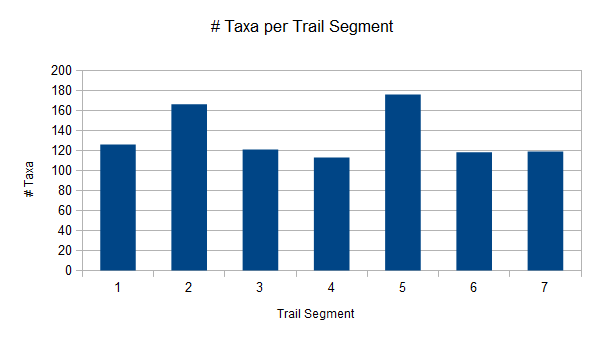
Fig. 1. The number of taxa found in trail segments A1 to A7. Segments A2 and A5 are the longest segments, and also have the greatest number of taxa found in their surveys. The other segments have virtually-identical observed number of taxa, despite a range in trail segment length from 2.3 to 10.5 miles (see Table 1).
The segments range from 2.3 miles for segment A1 to 17.5 miles for segment A2, with the longest segment almost eight times as long as the shortest segment. However, the number of taxa found on each segment ranges only from 113 taxa on segment A4 to 176 taxa on segment A5, a factor of only 1.6.
The reason why the number of taxa varies so much less than the ratio of the mileage is that many botanical studies have found that the number of species in an area increases much less rapidly than the area increases. This makes sense, since neighboring areas often have similar habitat, with similar taxa in them. Additional taxa appear only when something in the environment changes, such as going from an open location to the shade of a boulder or tree, from a south slope to a west slope, a change in the elevation, a change in the soil type, and other changes that are less easy for a human to observe, such as different night-time temperatures or different winds at different times of year. Every good field botanist has an eye for observing micro-habitats where they expect to see some new species in a given survey.
Fig. 2 plots the number of taxa found in each segment vs. the mileage of each segment, along with a model of the usual increase of the number of taxa with area (in this case, vs. distance).

Fig. 2. The number of taxa found in each of the trail segments A1 to A7 plotted versus the segment length. The red smooth curve is a best-fit power-law model of the expected increase in taxa versus distance. The three segments farthest from the model fit are labeled.
Given the differences in survey coverage for each segment, from the number of times each segment was covered, the dates each segment was covered, and the number of people doing the survey for each segment, the number of taxa found for each segment is fairly close to expectations. Possible reasons why three segments deviate from the model fit are:
- Segment A1 perhaps has more taxa than expected because it was the only segment to be covered in the fall and have monsoonal species found in its flora, and also because it has a large variation in habitats in its short distance.
- Segment A5 perhaps has more taxa than expected because it was surveyed three times, in different months in different years, and it also has the largest elevation change within it of any segment by almost a factor of two — 2,050 feet of elevation range within it, compared to 1,185 feet of elevation range for the segment with the next-largest elevation range.
- Segment A6 perhaps has fewer taxa than expected because it was only surveyed once, on 28 April 2003, when only about half the species were in bloom, and because it has a fairly uniform habitat along its entire length.
Of course, chance also plays a role in the observed differences. One expects a statistical one-standard-deviation variation of the observed numbers equal to the square root of the model predicted number, in this case 10 to 13 taxa. It is not unusual to observe a deviation of two standard deviations, in this case 20 to 26 taxa. Only section A1 deviates more than could be explained by chance.
Analysis of the number of segments in which each taxon was found, using the flora of all segments
In the combined flora from all segments, one can count up how many segments in which each taxon was found. For example, the first taxon in the list, Selaginella bigelovii, was found on three segments, A1, A2 and A5. The second taxon in the list, Azolla filiculoides, was found on two segments, A3 and A4. The third taxon, Dryopteris arguta, was found on only a single segment, A2.
We can take the number of segments for each taxon to count the number of taxa found on only a single trail segment; the number found on two trail segments, up to the number of taxa found on all seven trail segments.
Table 2 gives the number of taxa that were found on 1 to 7 trail segments in which the 334 taxa are found, and Fig. 3 plots those numbers. Table 2 also gives the percent of the 334 taxa found on a given number of trail segments.
Table 2. # of Taxa found on 1 to 7 Trail Segments
| # of segments | # Taxa | % Taxa |
|---|---|---|
| 1 | 100 | 30 |
| 2 | 82 | 25 |
| 3 | 60 | 18 |
| 4 | 31 | 9 |
| 5 | 19 | 6 |
| 6 | 18 | 5 |
| 7 | 24 | 7 |
| Total | 334 | 100 |
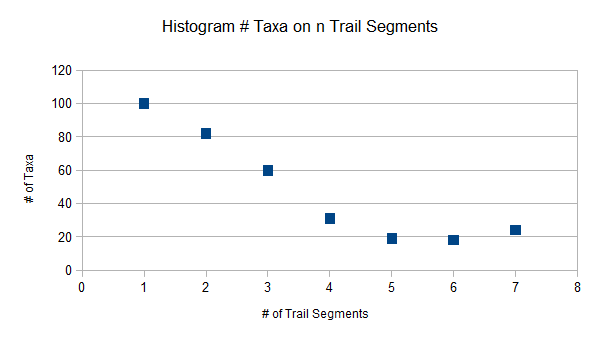
Fig. 3. Histogram of the number of taxa found on 1 to 7 trail segments.
These are quite standard results, which are a direct consequence of the observation that the number of species increases with area. In order to pick up more species with area, there have to be species found in only some areas. The observed usual increase of the number of species directly implies that most species are found in few areas. For more discussion of this fact, with examples from other species lists, see How Common Are The Plants Of Southern California?.
It is worth noting that it is entirely expected that there will be taxa found in only 6 out of the 7 trail segments, and that this is not in general a problem with the completeness of the surveys. Even if future surveys of these sections find some of these taxa in the segment where they were formerly missing, those surveys are equally likely to find an additional occurrence of taxa formerly found in 5 out of the 7 trail segments, promoting them to the 6 out of 7 trail segment list. Hence the shape of this histogram will likely remain the same as more surveys are done in these segments, with the previous list of found taxa moving to higher observed number of trail segments, and being joined by newly-found taxa that occur on only one trail segment.
Table 4 gives the number of taxa unique to a given trail segment, as well as the number of taxa that are not present from that segment, but which are found in the other six segments (these are taxa present in 6 out of 7 segments).
Table 4. # of Taxa Unique to a Trail Segment, and # of 6 out of 7 Taxa Absent in a Trail Segment
| Segment | # Taxa Unique to Segment | # Taxa Absent in Segment found in all other segments |
|---|---|---|
| A1 | 16 | 3 |
| A2 | 28 | 2 |
| A3 | 12 | 5 |
| A4 | 3 | 2 |
| A5 | 22 | 1 |
| A6 | 8 | 3 |
| A7 | 11 | 2 |
| Total | 100 | 18 |
The total number of taxa unique to each of the segments totals 100, the same number as given in Table 3 for taxa observed on only one segment. The total number of taxa observed on 6 out of 7 segments is 18, again the same number as given in Table 3.
The number of taxa absent from a given segment is very uniform between segments, ranging only from 1 to 5, with most segments have 2 or 3 "absent" taxa.
The variation in the number of unique taxa is much larger, ranging from just 3 taxa in A3 to 28 taxa in A2. The two sections with the largest number of unique taxa are also the two longest sections, which provides more opportunity to find different habitats that might not be present in the other segments. The segment with the smallest number of unique taxa is A4, with just 3 unique taxa. It is the second shortest segment, and was surveyed fewer times, by fewer people, at fewer times of year, than the shortest segment.
Analysis of the number of segments in which each taxon was found, using the flora of an individual segment
The previous analysis was done for the entire list of 334 taxa found from all segments A1 to A7. One can also ask the question: of the taxa found on a single segment, what is the average number of segments in which those taxa are found? I.e., if one considers only the 126 taxa found in segment A1, or only the 166 taxa found in segment A2, what is the histogram of their number of segments?
These taxa will have a higher average number of occurrences, since the large number of taxa found on only a single trail segment in other trail segments are not in the plant list for that single trail segment.
The total number of occurrences for each taxon is simply the number of times it was seen in the seven surveys. A taxon found on all seven segments has seven occurrences in the set of seven trail segment floras; a taxon found on six segments has six occurrences in the set of seven trail segment floras, etc. The number of occurrences for the entire taxon list can be easily computed by taking the numbers in each line of Table 2 for the # Taxa, and multiplying them by the # of segments. For example, the 100 taxa seen on only one segment have a total of 100 occurrences; the 82 taxa found on two segments have a total of 82*2 = 164 occurrences, etc. The 334 taxa have a total of 939 occurrences.
Another way to think of the list being analyzed in this section is to take the checklist for A1, add to that the checklist for A2 repeating taxa seen in both lists, add to that the checklist for A3 in the same way, etc. That list would have 939 entries (= occurrences), with most taxa being repeated at least once in the list.
The number of such occurrences for all taxa found in A1 to A7 is given in Table 5 and Fig. 4.
Table 5. # of Occurrences for taxa found on 1 to 7 Trail Segments
| # of segments | # Taxa | % Taxa |
|---|---|---|
| 1 | 100 | 0.11 |
| 2 | 164 | 0.17 |
| 3 | 180 | 0.19 |
| 4 | 124 | 0.13 |
| 5 | 95 | 0.10 |
| 6 | 108 | 0.12 |
| 7 | 168 | 0.18 |
| Total | 939 | 1.00 |
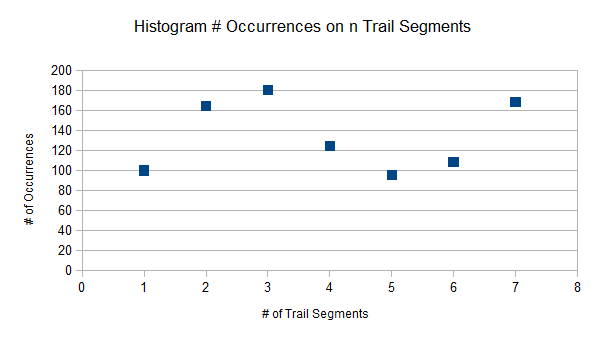
Fig. 4. Histogram of the number of the 939 occurrences of the taxa found on 1 to 7 trail segments.
The number of occurrences is much more constant, with a variation of only a factor of 1.8, compared to a factor of 5 in the histogram in Table 2. To a first approximation, a given taxon in the flora of a given segment is as likely to be found only on that segment as it is to be found on all seven segments, or in fact on any number of other segments. The actual average number of segments for the taxa found in the individual floras of A1 through A7 is 4.1, 3.8, 4.2, 4.5, 3.7, 3.9, and 4.2, an average of 4.1, close to the 4.0 it would be if a taxa were exactly equally likely to be found in any number of other segments.
Summary of the Analysis of the Number of Segments in which each Taxon was found
To recap the different numbers present above:
- If one looks at the list of 334 taxa from the flora of all segments A1 to A7, with each taxon listed a single time, the average number of segments for those taxa is 2.8, the median number of segments is 2, and the most likely number of segments is 1.
- If one looks at the flora of a single segment, the average number of segments for taxa in that flora alone is 4.1, with an individual taxon being almost equally likely to be found on any number of other segments (the "almost" encompasses the variation of ~30% shown in Table 5 and Figure 4.) These numbers derive from the list of 939 occurrences of all taxa in the concatenation of all the segment checklists.
The fundamental reason why these numbers differ is that the number of uncommon taxa accumulate in the combined flora of all segments, whereas the large number of observations for the common taxa increases the number of occurrences for those taxa. For more discussion of why these numbers differ, using a simple example of three segments each with three species, see How Common Are The Plants Of Southern California?.
Percent of Taxa in Common vs. Distance Between Segments
The floras of the individual segments can be compared to see how the number of taxa in common between segments falls off with increasing separation of the segments. Table 6 gives the number of taxa in common between the segments.
Table 6. # of Taxa in Common Between Different Trail Segments
| A1 | A2 | A3 | A4 | A5 | A6 | A7 | |
|---|---|---|---|---|---|---|---|
| A1 | 126 | 92 | 68 | 72 | 65 | 41 | 50 |
| A2 | 92 | 166 | 78 | 82 | 87 | 49 | 62 |
| A3 | 68 | 78 | 121 | 68 | 70 | 49 | 58 |
| A4 | 72 | 82 | 68 | 113 | 73 | 45 | 57 |
| A5 | 65 | 87 | 70 | 73 | 176 | 95 | 82 |
| A6 | 41 | 49 | 49 | 45 | 95 | 118 | 69 |
| A7 | 50 | 62 | 58 | 57 | 82 | 69 | 119 |
Each entry in Table 6 gives the number of taxa in common between the segment given at the left of the row and the one given at the top of the column. The entries in blue compare a segment with itself, and thus simply give the number of taxa in a given segment (e.g., 166 in segment A2). For example, the entry with row labeled A2 and column labeled A4 is 82, indicating that there are 82 taxa in common between those two segments.
This table is of course symmetric about the diagonal, since the number of taxa in common between A2 and A4 is the same as the number of taxa in common between A4 and A2.
Table 7 gives the fraction of taxa in common comparing one segment with another. This is not a symmetric process since the segments have a different number of taxa. In Table 7, the entries in the upper right of the table give the percent of taxa from the list in the column segment to the one at its left. The entries in the lower left of the table give the percent of taxa from the list in the row segment to the one above it.
An example comparing the flora of segment A1 to A2 will make this clear. A1 has 126 taxa; A2 has 166 taxa; and they have 92 taxa in common. The 92 taxa in common are 73% of the taxa in A1, but only 55% of the taxa in A2. Thus row A1, column A2 has an entry of 0.73, whereas row A2, column A1 has an entry of 0.55.
Table 7. Fraction of Taxa in Common Between Different Trail Segments
| A1 | A2 | A3 | A4 | A5 | A6 | A7 | |
|---|---|---|---|---|---|---|---|
| A1 | 1.00 | 0.73 | 0.54 | 0.57 | 0.52 | 0.33 | 0.40 |
| A2 | 0.55 | 1.00 | 0.47 | 0.49 | 0.52 | 0.30 | 0.37 |
| A3 | 0.56 | 0.64 | 1.00 | 0.56 | 0.58 | 0.40 | 0.48 |
| A4 | 0.64 | 0.73 | 0.60 | 1.00 | 0.65 | 0.40 | 0.50 |
| A5 | 0.37 | 0.49 | 0.40 | 0.41 | 1.00 | 0.54 | 0.47 |
| A6 | 0.35 | 0.42 | 0.42 | 0.38 | 0.81 | 1.00 | 0.58 |
| A7 | 0.42 | 0.52 | 0.49 | 0.48 | 0.69 | 0.58 | 1.00 |
As expected, the percent of taxa in common gets smaller as the distance between segments increases. Fig. 5 plots the numbers in Table 7, in the form of the average for a given segment distance, as well as the minimum and maximum for a given segment distance. Fig. 5 shows that on average, neighboring segments share 60% of the number of taxa in one of their lists, but segments separated by 4 to 6 segments share only 40% of their taxa. But there is considerable variation between neighboring segments. Some share 80% of their taxa; some only share 40% of their taxa.
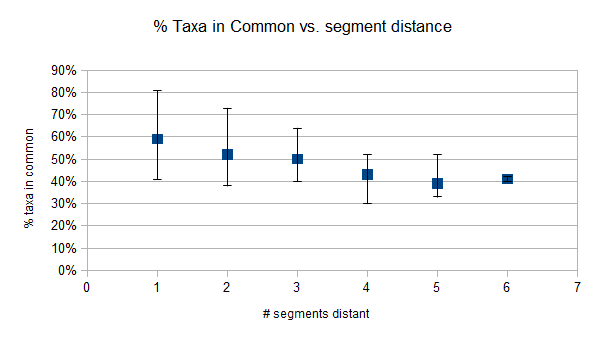
Fig. 5. Plot of the average, minimum and maximum percent of taxa shared between segments separated by a given number of segments. On average, neighboring segments share 60% of the number of taxa in one of their lists, but segments separated by 4 to 6 segments share only 40% of their taxa.