We have acquired copies of photographs taken from 1883 to 1890, and are attempting to take similar photographs today. The combination will show the changes that have occurred in the last 110-117 years.
Photograph 11126 was taken from this position, looking westward: (map to be added later).
We have been able to almost duplicate this photograph, although we haven't yet found the exact position from which the original was taken. It is possible that a large laurel sumac bush is currently preventing access to the exact location, and further that the picture was taken from a vantage point that is higher than the current ground level behind that rock:
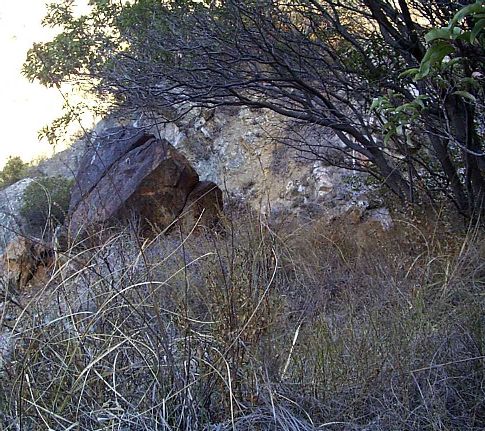
Note the large rock with a crack in it, which has a large laurel sumac to the right. The rock perhaps is the rock marked with "7" in the photograph below.
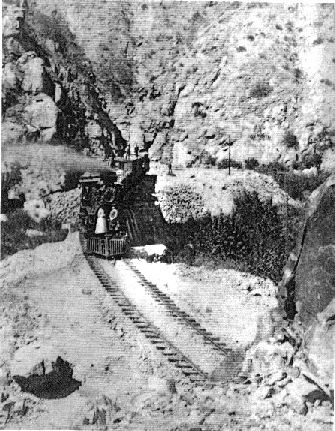
The short shadows in the original photo indicate that it was taken in summer around noon. Our new photo was taken in winter in the afternoon, which resulted in extreme contrast between the shaded foreground and the illuminated background on the right. Hence we had to piece together different photographs to produce reasonable exposures for most of the picture. We haven't used PhotoShop, which probably would do a much better job of putting these photos together. However, nothing would really substitute for taking this picture again in the summer, so that the illumination pattern can match the older picture much more closely.
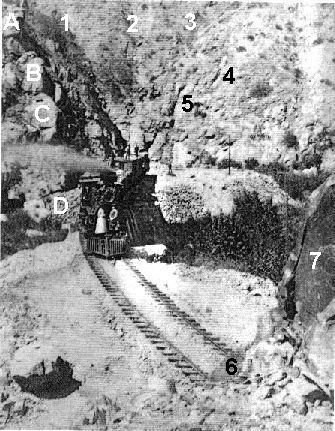
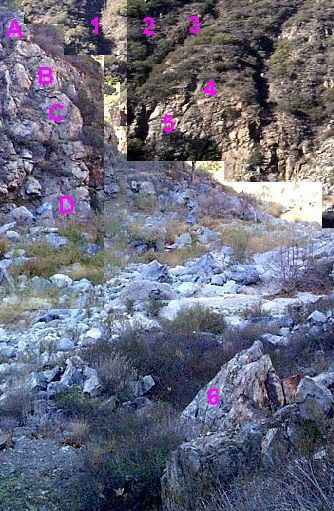
Here is a side by side comparison of the photos, with matching features labeled:
 | 
|
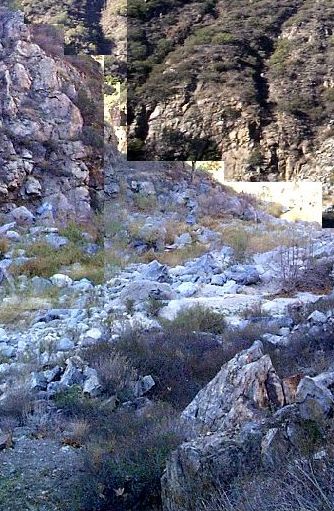
Here is a side by side comparison of the photos, with no labels:
 | 
|
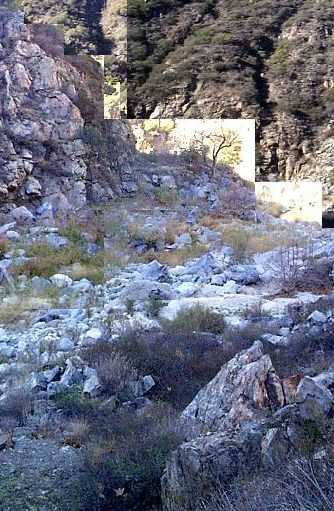
Here is a side by side comparison of the photos, now with part of the background obscured near the railroad bench so that the bench can be more clearly seen:
| | 
|
Notes on the comparison:
- Boulder A has a rock with a very white linear rim below it which is prominent in both pictures.
- Boulder B has the same clear "nose" sticking out to the right about 1/4 of the way down. The nose is less prominent in the new picture due to lack of shadowing. The boulder to the left of Boulder B is also nearly identical in the two pictures.
- Boulder C has an "eyebrow" above the letter "C" due to a rock overhang; a similar "mouth" below the letter "C", that differ in the two pictures only by the shadowing. The face of Boulder C, facing right in the picture, is in shadow in the old photograph, but it can still be seen that the shape is identical.
- Smoke from the train obscures the rock below boulder C in the old picture. Below the smoke and above the letter "D" is a prominent crack in the rock face.
- We have no idea what is to the left of the letter "D", but perhaps there is a remnant of whatever it is in the center of it in the new picture.
- The River is still in the same position today as it was then, hugging its left bank.
- Gullies 1, 2 and 3 are more visible in today's picture, perhaps due to the low sun angle.
- Small rills 4 and 5 appear to be enlarged today.
- The railway bed today only extends to the vertical position between "4" and "5", despite extending well past "5" before.
- Boulder 6, if this is indeed a correct matchup, shows up very peculiarly in the older photograph. You can see it best by noting how it appears to "cut off" the railroad tracks, which are disappearing to the lower right of the picture into a road cut well below the vantage point of the photo. However, it is also possible that Boulder 6 and the darker rock above it (Boulder 7) are simply no longer present today.